
Why simple jewelry software can create complex business problems
In the dynamic world of jewelry, the allure of "easy-to-use" software is undeniable. It promises quick setup, minimal training, and a smooth transition. However, for serious jewelers - those managing intricate custom orders, diverse inventory, complex manufacturing processes, and multi-channel sales - the path of least resistance often leads to significant operational hurdles.
A Short Story or Example:
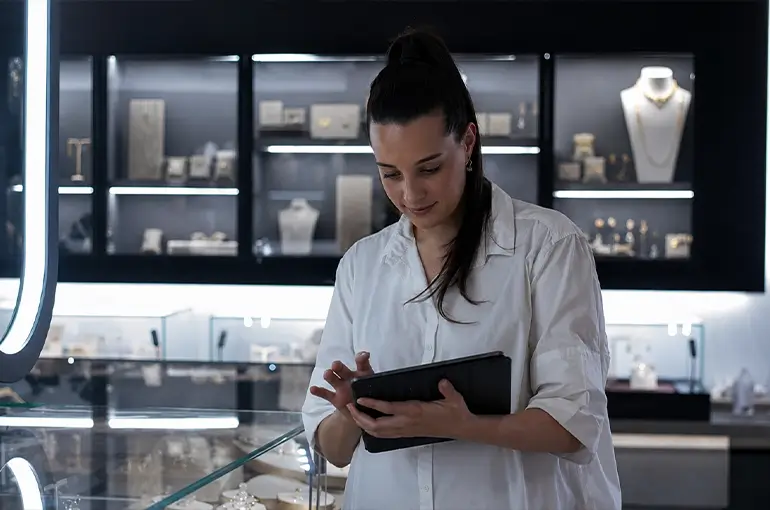
Consider a thriving jewelry boutique that, eager to modernize, adopted a sleek, seemingly intuitive software system. The demo was impressive: clean interface, simple navigation, and promises of effortless management. Initially, the team was delighted. Sales were recorded, basic inventory tracked, and daily operations felt smoother.
However, as the business grew, so did its complexities. Custom engagement rings required intricate stone tracking and multiple manufacturing steps. Repairs piled up, each with unique material needs and customer communication. Wholesale orders demanded detailed invoicing and multi-location inventory transfers. Soon, the limitations of the "easy" software became glaringly apparent.
The team found themselves reverting to spreadsheets for custom orders, using sticky notes for repair statuses, and manually reconciling inventory across systems. Data became disconnected, visibility plummeted, and what once felt easy transformed into a chaotic, inefficient mess, proving that initial simplicity often masks underlying operational fragility.
1. Why “easy” is attractive at first
For many jewelry business owners, the appeal of "easy" software is immediate and understandable. In a fast-paced industry, the promise of rapid onboarding, intuitive interfaces, and minimal staff training is highly attractive. Clean, uncluttered screens and straightforward workflows can seem like a breath of fresh air, especially when compared to the perceived complexity of more robust systems.
This initial ease often translates to less resistance from employees during adoption, making the transition appear seamless. The desire to avoid steep learning curves and immediate operational disruptions drives many to choose solutions that prioritize simplicity above all else. It feels comfortable, manageable, and, at first glance, perfectly adequate for their needs.
2. The problem: jewelry operations are not simple
Beneath the sparkle and allure, the operations of a jewelry business are anything but simple. Unlike many retail sectors, jewelry involves a unique blend of manufacturing, bespoke craftsmanship, and high-value inventory management. Consider the nuances:
Diverse inventory: beyond finished pieces, jewelers manage loose stones (diamonds, gemstones), various metal types (gold, silver, platinum in different karats), and components. Each requires meticulous tracking, often by weight, purity, and specific attributes.
Custom orders & repairs: these are the lifeblood of many serious jewelers but introduce immense complexity. Custom designs involve multiple stages from CAD to casting, stone setting, and finishing. Repairs demand tracking customer items, materials used, labor, and progress through various workshops.
Manufacturing workflows: for those who manufacture in-house or outsource, managing production jobs involves detailed bills of materials, routing through different workstations, tracking work-in-progress, and ensuring quality control at each step.
Multi-channel sales: jewelers often sell through retail stores, wholesale channels, e-commerce platforms, and even trunk shows. Each channel has distinct inventory allocation, pricing, and fulfillment requirements.
Accounting & compliance: integrating sales, purchases, and manufacturing costs into accounting systems is crucial for accurate financial reporting and tax compliance. Tracking precious metals and stones also comes with specific regulatory demands.
An "easy" software system, designed for generic retail, often lacks the granular detail and specialized workflows needed to manage these complexities effectively. It might handle a simple sale, but it falters when faced with a custom order for a platinum ring with three different diamond cuts, requiring a specific vendor for casting, an in-house setter, and a final polish before delivery.
3. When easy software becomes expensive
The initial appeal of "easy" software quickly fades when its limitations begin to manifest as hidden costs. What seemed like a cost-effective solution can rapidly become a drain on resources and profitability. These hidden expenses often include:
Reliance on spreadsheets: when the software can't handle specific workflows, businesses inevitably resort to manual workarounds. Spreadsheets become the unofficial ERP, leading to fragmented data and version control nightmares.
Duplicate data entry: information entered into one system often needs to be manually re-entered into another (e.g., POS data into accounting, custom order details into production tracking). This is not only time-consuming but also a major source of errors.
Inventory errors and discrepancies: simple systems struggle with the nuanced tracking of precious metals, stones, and components. This can lead to inaccurate stock counts, lost items, difficulty in reconciliation, and ultimately, financial losses.
Missed deadlines and poor customer communication: without integrated workflows and real-time visibility into production status, custom orders and repairs can easily fall behind schedule. This results in frustrated customers and damaged reputations.
Lack of accountability and reporting: generic software often provides only basic reporting, making it difficult to pinpoint inefficiencies, track individual performance, or gain strategic insights into the business. This lack of data-driven decision-making can stifle growth.
Operational inefficiency: the cumulative effect of these issues is a significant drag on operational efficiency. Employees spend more time on administrative tasks and problem-solving than on value-adding activities, impacting productivity and morale.
4. Why serious jewelers need operational depth
Serious jewelers understand that their business is inherently complex, and their software should reflect that reality, not shy away from it. Operational depth in jewelry software isn't about making things unnecessarily complicated; it's about providing the structured framework and granular control necessary to manage intricate processes accurately and efficiently. This means software that:
Mirrors real-world workflows: the system should be designed with an understanding of jewelry-specific processes, from design and CAD to casting, stone setting, polishing, and quality control. It should allow for the creation of custom workflows that match the unique operations of each business.
Ensures data accuracy and integrity: with high-value inventory and custom work, precision is paramount. Deep software capabilities ensure that every stone, every gram of metal, and every labor step is accurately recorded and tracked, minimizing errors and preventing loss.
Provides comprehensive visibility: serious jewelers need to know the status of every order, every repair, and every piece of inventory at any given moment. This requires robust reporting, dashboards, and real-time updates that simple systems cannot offer.
Supports customization and scalability: as businesses evolve, their software needs to adapt. A deep system allows for customization to accommodate new product lines, changing manufacturing techniques, or expanding sales channels, ensuring it grows with the business rather than becoming a bottleneck.
Integrates key functions: a truly effective system brings together disparate functions - inventory, manufacturing, sales, CRM, accounting—into a unified platform. This eliminates data silos, reduces manual entry, and provides a holistic view of the business.
5. The difference between easy software and usable software
This distinction is crucial for jewelers evaluating software solutions. Many conflate "easy" with "usable," but they are fundamentally different concepts:
Easy software removes complexity: it achieves simplicity by omitting features, abstracting away details, or forcing users into rigid, generic workflows. While this might make initial adoption quick, it often leaves critical operational gaps for a complex business like jewelry.
Usable software organizes complexity: it acknowledges the inherent intricacies of the jewelry business and provides tools to manage them effectively. Usable software is designed to handle detailed inventory, multi-stage manufacturing, custom order variations, and diverse sales channels without overwhelming the user. It offers intuitive interfaces and logical workflows that make complex tasks manageable, rather than eliminating the tasks themselves.
The goal for a serious jeweler should not be to find software that avoids complexity, but rather one that embraces and organizes it, providing clarity and control over every facet of their operations.
6. Why implementation should not be rushed
Implementing a comprehensive jewelry ERP (Enterprise Resource Planning) system is a significant undertaking, and rushing the process can undermine its long-term benefits. Unlike plug-and-play solutions, a robust ERP requires careful configuration to align with a business's unique workflows, inventory rules, production steps, user permissions, and integration needs. This is not a sign of weakness in the software; rather, it's an essential part of building a reliable and tailored operating system for the business.
A proper implementation involves:
Workflow mapping: analyzing and digitizing existing business processes, identifying areas for optimization.
Data migration: carefully transferring historical data, ensuring accuracy and consistency.
Customization & configuration: tailoring the software to specific business requirements, such as unique product attributes or manufacturing sequences.
Training: ensuring all staff are proficient in using the new system, understanding its capabilities and how it supports their daily tasks.
Integration: connecting the ERP with other essential systems like accounting software, e-commerce platforms, or CAD tools.
While this process demands time and resources, it lays the foundation for a highly efficient, accurate, and scalable operation. Viewing implementation as an investment in future stability, rather than a quick fix, is critical for serious jewelers.
7. Where PIRO fits
For jewelers who recognize the need for operational depth and a system that can truly support their growth, platforms like PIRO offer a compelling solution. PIRO is a cloud-based jewelry ERP and POS software specifically designed to address the intricate demands of jewelry manufacturing, wholesale, retail, and businesses with complex inventory and production workflows. It provides:
Comprehensive inventory management: tracking of finished goods, loose stones, metals, and components with granular detail.
Advanced production control: tools for managing multi-stage manufacturing processes, custom orders, and repairs from inception to completion.
Workflow visibility: real-time insights into every step of the business, ensuring transparency and accountability.
Scalability and customization: the ability to adapt to evolving business needs, supporting growth without compromising data integrity or operational efficiency.
Integrated ecosystem: connecting various business functions to eliminate data silos and streamline operations.
Crucially, PIRO is built for the reality of the jewelry industry, understanding that true efficiency comes from organizing complexity, not avoiding it. It aims to be a reliable operating system that empowers jewelers to manage their unique challenges with confidence, rather than a simple tool that falls short when the business truly needs it.
Strategic takeaway:
The right jewelry software should not just feel easy on day one. It should still work when the business becomes more complex. It should be a foundation that supports growth, not a ceiling that limits potential. Serious jewelers understand that true operational excellence comes from embracing and managing complexity with purpose-built tools, not from seeking superficial simplicity.
In conclusion, while the initial appeal of "easy-to-use" jewelry software is understandable, serious jewelers must look beyond first impressions. The true value of a software solution lies in its ability to handle the inherent complexities of the jewelry business - from intricate inventory and custom manufacturing to multi-channel sales and detailed reporting. Evaluating software based on its long-term operational fit, its capacity to organize complexity, and its potential to scale with your business will ensure you choose a partner that empowers your growth, rather than one that creates unforeseen limitations down the line.
If you are a serious jeweler seeking a robust, purpose-built solution that understands and organizes the complexities of your business, we invite you to explore PIRO.
Discover how a truly capable jewelry ERP and POS platform can provide the operational depth, accuracy, and control you need to thrive.
You can book a consultation here.
FAQ:
What is PIRO jewelry software?
PIRO is a cloud-based jewelry ERP (Enterprise Resource Planning) and POS (Point of Sale) software designed specifically for the jewelry industry. It helps manage manufacturing, wholesale, retail, and businesses with complex inventory and production workflows.Is PIRO only for retail jewelers?
No, PIRO is designed for a wide range of jewelry businesses, including manufacturers, wholesalers, and retailers. It supports the unique needs of each segment, from production control to multi-channel sales.Can PIRO support manufacturing and custom orders?
Yes, PIRO offers advanced production control features to manage multi-stage manufacturing processes, custom orders, and repairs, providing comprehensive tracking from start to finish.Does PIRO help with jewelry inventory accuracy?
Absolutely. PIRO provides comprehensive inventory management, allowing for granular tracking of finished goods, loose stones, metals, and components, which is crucial for maintaining accuracy in high-value jewelry inventory.Can PIRO replace spreadsheets?
Yes, PIRO aims to eliminate the need for fragmented data and manual workarounds often associated with spreadsheets. By integrating various business functions, it provides a unified platform for all operational data.How long does implementation usually take?
Implementation time can vary depending on the complexity of your business and specific customization needs. A proper ERP implementation involves careful configuration, data migration, and training to ensure it aligns perfectly with your workflows, making it a thorough, rather than rushed, process.Is PIRO suitable for growing jewelry businesses?
Yes, PIRO is built with scalability and customization in mind. It adapts to evolving business needs, supporting growth without compromising data integrity or operational efficiency, making it ideal for expanding jewelry businesses.